Exploring the vast and exciting world of medievalism all around us.

Saturday, September 25, 2010

Dante Cheese


So into the brave world of medievalism comes a new entry, Dante Cheese. On the left here see the Dante Cheese mascot. More information about Dante Cheese can be found at the Wisconsin Sheep Dairy Association website. As you can see from the mascot, draws on Dante as inspiration for Rodin's thinker. Only now Dante is a sheep. Since we're supposed to imagine, I believe, that Dante (after spending some time in Purgatory on the terrace of the proud) ends up in Paradise, does this mean the sheep have been separated from the goats? But we love goat cheese also!
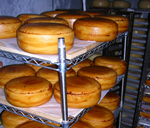

Dante cheese also has a lovely red rind, as you can see above. So is this to remind us of the fires of hell? Hard to know. The cheese, however, is delicious. Here is its description from the abovementioned website:
"Made with 100% pure sheep milk and aged a minimum of six months, DANTE has a firm and somewhat dry texture. DANTE complements pasta, dried fruit, and balsamic vinegar as well as medium red wines and semi-sweet white wines."
Dante cheese can be purchased at the WSDC website, which also has a list of local retailers

Saturday, September 4, 2010

Medieval Drama--more from the Summer of Medievalism

The Brooklyn Friends Middle School's Spring Play this year was the Canterbury Tales! It was a big surprise; they didn't really edit a whole lot for the audience, so we got to see a whole lot of Chaucer, but with interesting anachronism. There seemed to be a lot more focus on Canterbury than there is in the actual text, and the language was either completely modern or taken out of the old Penguin translation by Neville Coghill. For some reason (lots of girls tried out?), the Prioress told the "Nun's Priest's Tale" (she probably couldn't have told her own tale, given the school's population!). Also featured were the Wife of Bath, the Miller (who ended up having to play Absolon himself), the Reeve (an unconventional choice!), the Franklin and the Pardoner, as well as a running joke about the Cook (played by a tiny girl) not being able to tell a tale. She fainted every time she tried.) It was a funny mix--lots of "grown up" stuff (no farting in the Miller's Tale, but the ass kissing and the poker made an appearance!) stayed in, but some of the more interesting stuff was left out. Which I guess is medievalism! The Middle Ages is constructed as a rollicking old time with funny, bawdy stories (romances and fabliaux, with the exception of the Pardoner), with Aesop like morals. It seemed funny that everyone complained about the Prioress telling a virtuous story when she told the Nun's Priest's Tale, which may have a morak, but also has canoodling chickens. (The chicken costumes were amazing.) There wasn't much sense of "moost sentence and moost solaas," but there was a lot of skipping around. They could have used better music--I thought they should have used some medieval tunes. But three cheers for the 6th and 7th graders and their teachers who put together a fun evening. A valiant effort! And a shout out to Maya Kaul, a most romantic Dorigen in her green guinevere dress, and also played death in the Pardoner's Tale.

Friday, August 27, 2010

A Summer of Medievalism


The Summer of 2010 (about to end for us in the academic world!) was ripe with medievalism. The idea for this blog arose when the Roaming Medievalist saw a man on the subway reading a book about Medieval Combat in Russian. Before anyone thinks the Roaming Medievalist is THAT multi-lingual, it was pretty clear from the somewhat dated black-and-white photographs that this was what the book was about. Was he reading for purely intellectual reasons, or becuase he was planning to engage in medieval combat? On the Subway? Was he planning to join the Russian Society for Creative Anachronism?

Later the RM discovered a relief sculpture of Dante's head on the facade of Tilden House, home of the the National Arts Club in Grammercy Park. (Grammercy Park South, between Irving and Park Avenue South, for those of you who wish to make a Pilgrimage. Dante was at the bottom right; at the top were Shakespeare and Milton, Benjamin Franklin in the middle, and Goethe on the lower line with Dante. Why Dante instead of Chaucer, and why these as the paragons of the arts?
The RM then ran across "The Last Defender of Camelot," an episode of the 1986 Twilight Zone. Richard Kiley played the immortal Lancelot, living in 1980s London. Morgana was a fortune teller. They, and a punk named Tom, went back to Stonhenge, where Merlin and Morgana died in a conflict with each other, while Lancelot and Tom survived. A great deal of dry ice died in the making of this episode, and it made not a lick of sense.

It was so hot this Summer that the RM ended up staying inside a great deal in the airconditioning. This meant watching far too much television, including some food shows. In the 2006 "Food Network Challenge, Birthday Cake Surprise," the competitors made medieval castle cakes for a kids birthday. In the end, the kid picked the white castle with pink turrets and green cartoonish dragon made out of rolled fondant over the chocolate castle replete with a huge spiked mace. On an episode of Cake Boss (TLC), Buddy Valastro made a cake for Medieval Times, replete with stands, a king and queen, and jousting knights on some kind of motored track that allowed them to ride towards each other. Buddy also got to joust with one of the knights at Medieval Times, in his chef's whites. He won, although it may well have been rigged. Then he was knighted by the king--how many bakers were knighted in the Middle Ages?

There are so many other examples, but the RM is now hungry from writing about all those cakes.


Thursday, August 26, 2010

Welcome to This Week in Medievalism


Welcome to "This Week in Medievalism," where the two scholars who constitute the Roaming Medievalist explore the vast and exciting world of Medievalism that is all around us. From carvings on the fronts of buildings, to people engaging in role-playing games in the park, to artworks in museums, and all sorts of other examples, we strive to bring you a wild and wide world of the past living in the present.